Buying Into The Gregory Ain Mar Vista Tract: The Restriction Is The Asset
August 20, 2026
August 20, 2026
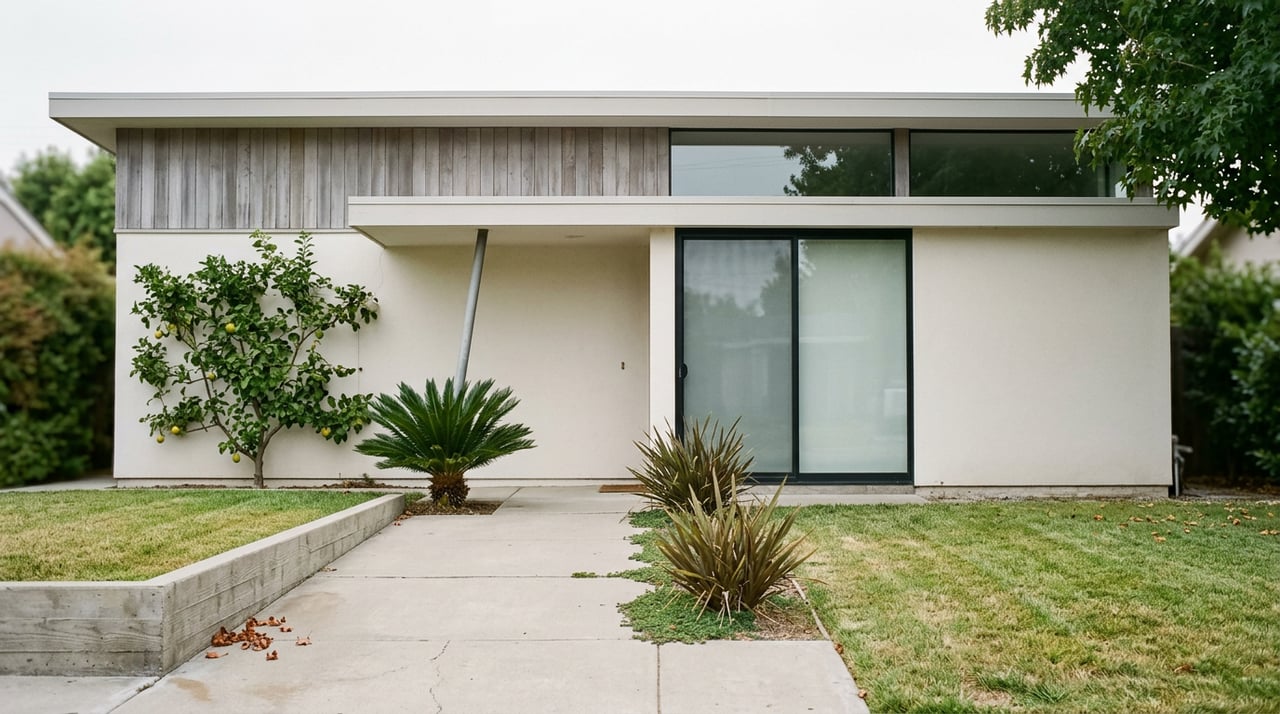
A buyer I worked with last year fell for a flat-roofed 1948 bungalow off Beethoven Street before she even saw the inside. Clerestory windows, a folding wall between the living room and what used to be a nursery, a carport that opened straight onto the kitchen. She was already picturing a primary suite over the garage. Then her contractor pulled the parcel and delivered the news that changes everything about how you plan a purchase here: that second story isn't happening, not on this lot, not with a permit, not ever, unless the city rewrites its own preservation plan for the tract.
That's the moment most buyers in the Gregory Ain Mar Vista Tract hit, usually after they've already fallen for the house and usually later in the process than they'd like. The tract is a 52-home enclave built in 1948, designed by architect Gregory Ain with Joseph Johnson and Alfred Day, landscaped by Garrett Eckbo, and marketed at the time as "Modernique Homes." Ain and his team had planned 100 houses on 60 acres, but the Federal Housing Administration balked at financing anything this stripped-down and modern, so only the first stage of 52 got built. In 2003, the tract became Los Angeles' first historic district made up entirely of Modern-style, post-World War II homes.
Here's the thing most guides to this neighborhood get backwards. They treat the historic designation as a cost, a list of things you're not allowed to do to your own house. The more useful way to read it, especially if you're weighing an offer or pricing a listing here, is that the restriction is not a tax on the property's value. It's a large part of where the value comes from.
The Historic Preservation Overlay Zone status means any exterior change visible from the street, or currently hidden by landscaping but that would be visible without it, goes through the tract's HPOZ Board before you can pull a permit. That includes the two changes buyers ask about most: you cannot add a second story, and you cannot alter the front facade. The city's adopted preservation plan for the tract spells out the review process in detail, and the board itself is made up of people appointed specifically for their expertise in historic preservation, architecture, real estate, and construction, not a generic planning committee working from a checklist.
Interior work is a different story. Alterations that don't change anything visible from the street are typically more flexible and often clear without a full board hearing. Kitchens, baths, HVAC, electrical panels, all fair game in most cases. The line the city actually cares about is what the house looks like from the sidewalk.
Step outside the tract's roughly three-block footprint and you're back in ordinary Mar Vista, governed by the citywide Baseline Mansionization Ordinance rather than a historic board. The BMO sets a base floor area ratio of 50% of lot size for R1 zones, with a 20% design bonus available for homes that meet certain criteria, effectively allowing up to 60%. No public hearing, no board review of your window trim, no restriction on adding a second story as long as you fit inside that envelope.
| Inside the Ain tract (HPOZ) | Rest of Mar Vista (BMO) | |
|---|---|---|
| Second story additions | Not permitted | Allowed within floor area limits |
| Front facade changes | Requires Certificate of Appropriateness and board review | Requires standard building permit only |
| Interior remodels (not visible from street) | Generally more flexible | Standard permit process |
| Who approves exterior work | HPOZ Board, public hearing | LADBS plan check |
That table is the whole friction point in one place. A buyer comparing two nearly identical 1948 bungalows, one inside the tract boundary and one two blocks east, is actually comparing two different regulatory regimes, not just two houses.
Here's what the restriction buys you. A contributing structure in the tract's HPOZ is eligible for a Mills Act contract with the City of Los Angeles, which can reduce annual property tax by 40 to 60 percent in exchange for the owner committing to maintain the historic property. On a Mar Vista-priced home, that's not a rounding error. It's real money every year, and it compounds over a long hold in a way that almost nothing else in California real estate does, because most tax relief mechanisms in this state are one-time or transaction-triggered. Mills Act keeps paying out as long as you own the house and hold up your end of the maintenance agreement.
So the same designation that stops a buyer from stacking a second story is the one that makes the annual cost of ownership meaningfully lower than an equivalent, unrestricted house nearby. You're not paying a premium for a restriction. You're buying into a smaller, protected pool of inventory that comes with a tax advantage built in.
That scarcity shows up in the sales data too. Robb Report tracked only four Ain-designed homes in the tract changing hands across a three-year span, with the most recent of those trading for close to $2.5 million in 2023. Compare that to the broader Mar Vista market, where single-family homes carried a median sale price near $2.1 million in early 2026, up roughly 8 percent over the prior year. Mar Vista overall is a fast-moving, competitively bid market right now. The tract inside it barely moves at all. Thin resale and steady buyer demand from architecture-minded households are exactly the conditions that hold value over time, and they're a direct product of a rule most people read as a limitation.
If you're under contract on a contributing property, or preparing to list one, the sequence matters more than it does on a typical Mar Vista transaction.
None of this is a reason to avoid the tract. It's a reason to walk in with a different set of questions than you'd bring to a standard Mar Vista purchase two blocks away.
Does this apply to all of Mar Vista, or just this one pocket? Just the tract. The HPOZ boundary covers the roughly 52 homes Ain, Johnson, and Day built in 1948. The rest of Mar Vista, including the post-war ranches and newer infill that make up most of the neighborhood, falls under the citywide Baseline Mansionization Ordinance instead.
Can I still update the kitchen or add central air? In most cases, yes. Interior alterations that don't change anything visible from the street are generally handled with more flexibility than exterior work, though it's worth confirming scope with HPOZ staff before you finalize plans.
Is the Mills Act tax reduction automatic once I buy? No. It requires an application and a contract with the city, and it applies to the property, not the buyer personally. Confirm the specific terms and any existing contract status before you build it into your budget.
Buying inside the Ain tract means accepting a smaller set of choices about what you can change. In exchange, you get a house that has held its shape for nearly eighty years, a buyer pool that shows up specifically because of that, and a tax mechanism that keeps working in your favor for as long as you own it. If you're weighing a house in the tract against one just outside its boundary, or you're ready to price a listing that carries this history, Janet Heinzle can walk you through what the designation means for your specific parcel before you write the offer. Let's Connect.
Stay up to date on the latest real estate trends.
Whether you’re buying, selling, or investing, Janet Heinzle offers clear guidance, strong advocacy, and a commitment to your success. Reach out today to begin a real estate experience defined by trust, transparency, and results.
Connect With Me To Learn More
11990 San Vicente Blvd Ste 100 Los Angeles, CA 90049